
A native desktop player for YouTube Music
Nixie plays your YouTube Music account through a desktop app for macOS, Windows and Linux instead of a browser tab. Free, MIT licensed, with no Nixie account, no backend and no telemetry.
An independent, unofficial client. Not affiliated with, endorsed by or sponsored by YouTube or Google, and it needs your own YouTube Music Premium subscription.
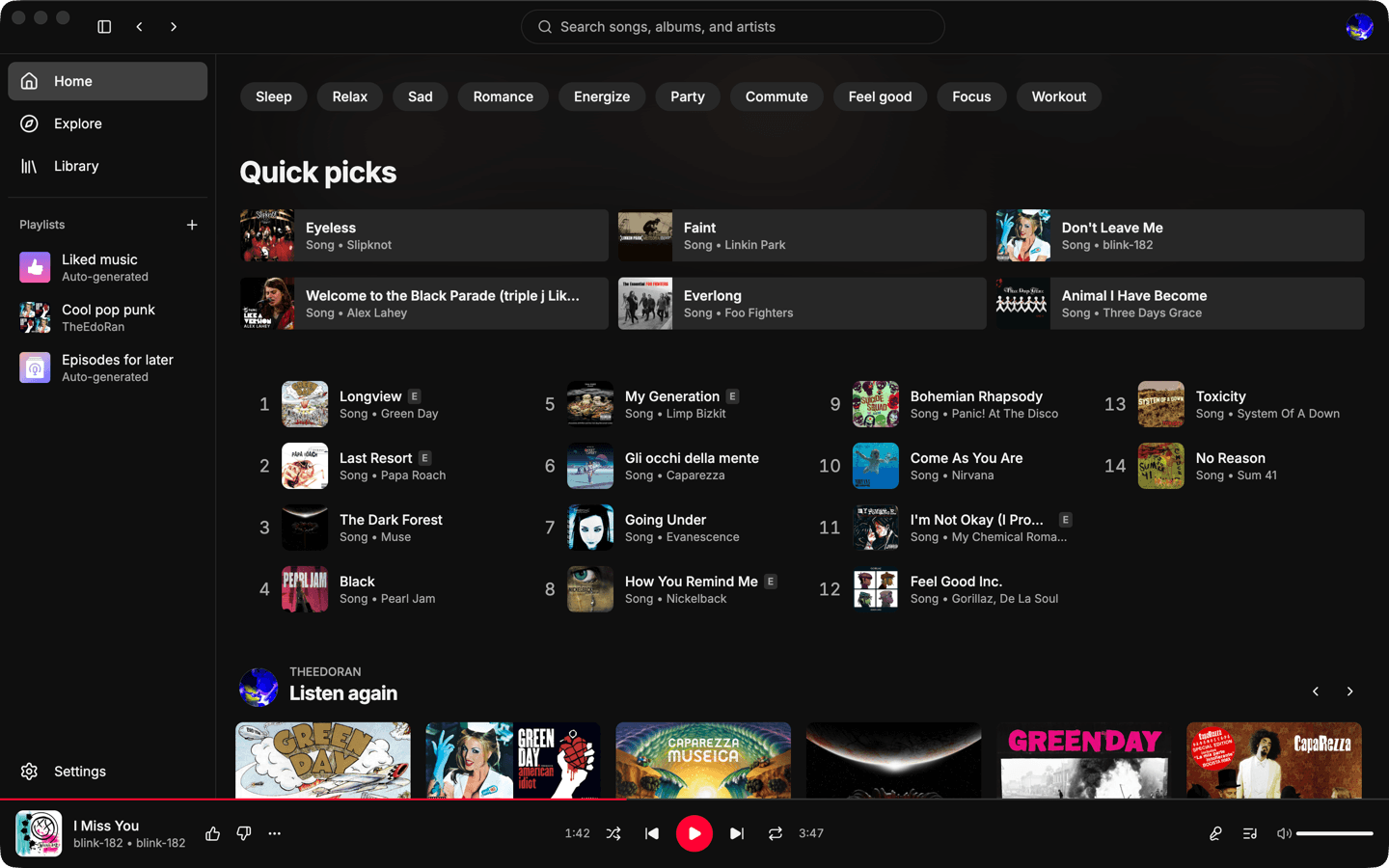
One track arrives mastered loud, the next one quiet, and you spend the evening on the volume key.
So you pick the loudness, once.
Three targets, the same three Spotify publishes. -14 LUFS is the default, because that is what YouTube itself aims for.
Integrated loudness, in LUFS
Close the tab, come back, start over.
So it comes back where you left it.
Reopen Nixie and everything is there, paused, with the stream already resolved so the first press of Space starts instantly. It comes back paused on purpose: an app that starts making noise before you asked it to is not a feature.
- the queue
- the current track
- the exact position in it
- the volume
- repeat
- shuffle
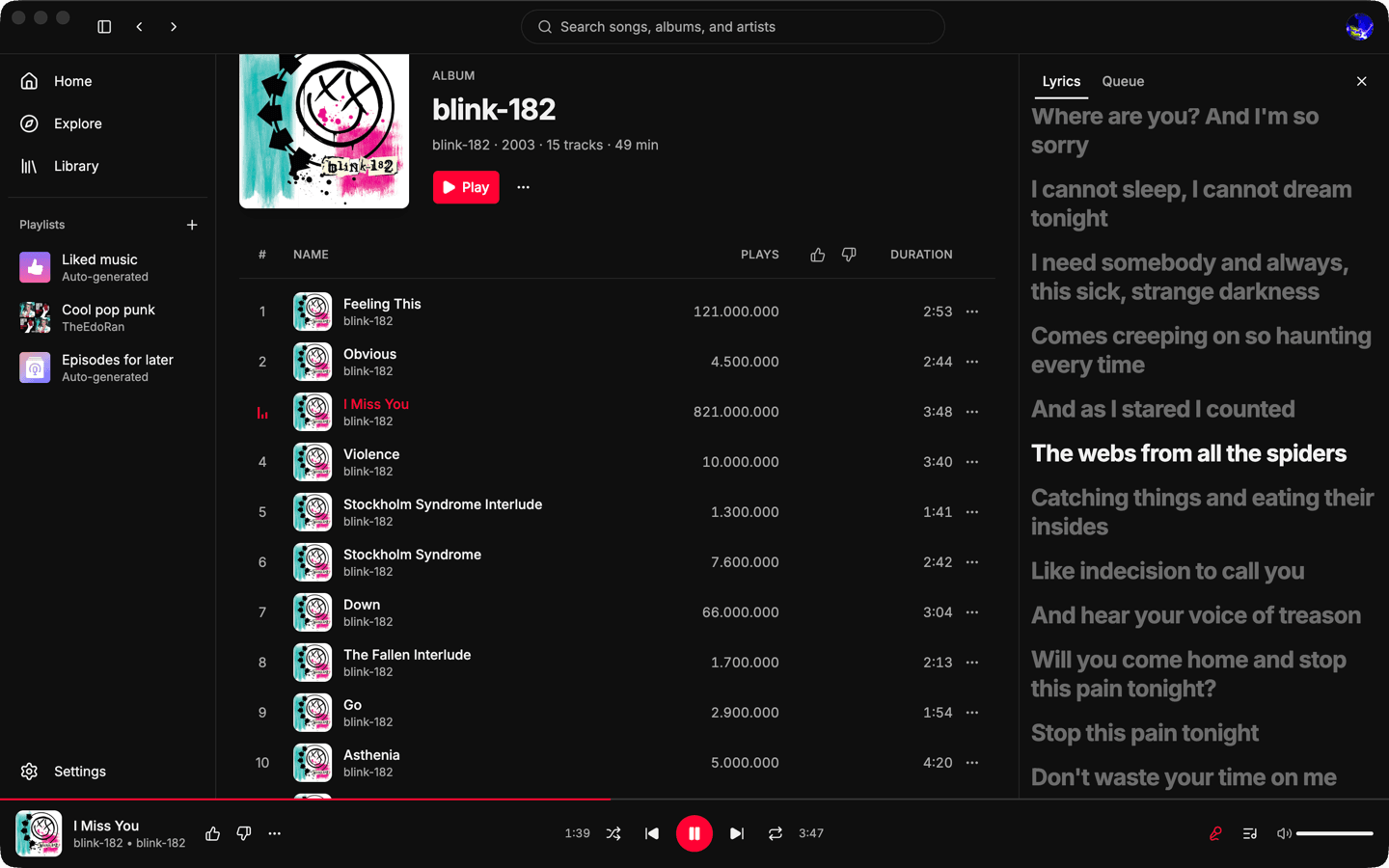
Lyrics are plain text, when they are there at all.
So three sources are asked, and the synced one wins.
LRCLIB, then NetEase, then YouTube Music, stopping at the first result good enough, so most tracks never get past the first request. Synced lyrics highlight the line you are on, scroll to keep it in view, and seek when you click one.
Everything else it does
Beyond those three it is simply nicer to use. A real track table, a persistent player, a queue you can see, keyboard shortcuts and media keys. A desktop app, not a web page in a frame.
Playback
- Loudness normalization at -19, -14 or -11 LUFS, or off.
- A volume slider that behaves like your ears do, not like a gain multiplier.
- Queue with play next, add to queue, reorder and remove. Repeat off, all or one. Shuffle.
- Radio from any track, album, artist or playlist.
- Autoplay extends an exhausted queue a full track before the end, so the music never stops to wait for a network request. You can turn it off.
- Three quality levels: data saver, balanced, or highest available.
Lyrics
- Time-synced when a source has them, plain text when it does not, and an explicit “instrumental” when there are none to find.
- Click any line to seek to it.
- Lyric requests carry no cookie and identify neither you nor your account, except to YouTube Music, which is asked over the session already streaming the audio.
Library and browsing
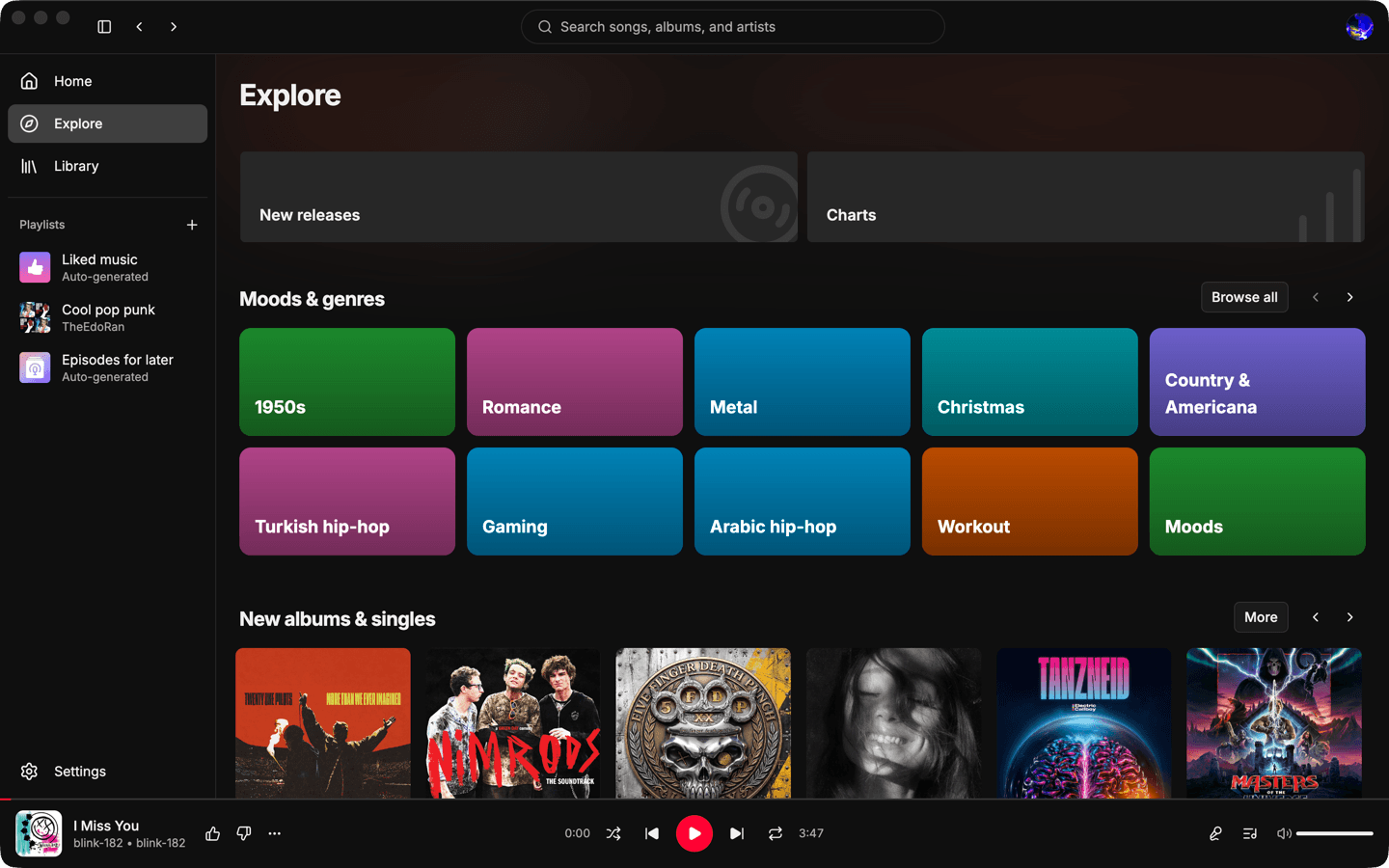
- Your home feed, mood chips and infinite scrolling included.
- Explore, with charts per country.
- Search with live suggestions, filtered by songs, albums, artists or playlists.
- Album, artist and playlist pages, with a real track table you can sort.
- Create, rename, describe, reorder, set the privacy of and delete playlists. Add and remove tracks, like, dislike, save to library, subscribe to artists.
- Podcasts too: shows and episodes, a Podcasts tab in your library, and a playlist of new episodes.
Desktop
- Now Playing in Control Center on macOS and in the media transport controls on Windows, with artwork, and hardware media keys everywhere they exist.
- A quiet notification naming the next track when the queue moves on by itself. Never while the window is focused, and never with a sound, because the only sound this app makes is the music.
- Keyboard shortcuts follow the platform: Cmd+K to search and Cmd+Left / Cmd+Right to change track on macOS, Ctrl+K and Ctrl+Left / Ctrl+Right on Windows and Linux. Swipe on a touchpad to go back and forward.
- In English and Italian. It opens in your system's language, and YouTube Music's own shelves and genres follow the same choice.
- Updates download in the background and install when you quit, on all three platforms.
Privacy
- No Nixie account, no backend, no telemetry, no analytics, no crash uploader.
- Plays go to your YouTube watch history, as they would in YouTube Music itself, so your recommendations keep up. One switch in Settings stops that.
- Diagnostics stay on your computer until you choose to copy or export a report, and you can read it first.
- Sandboxed renderer, context isolation, a strict content security policy and validated IPC. Media and artwork are served through a restricted custom protocol, so the interface never holds a signed URL or a filesystem path.
There is no password field
Google refuses sign-in from an embedded browser window, and refuses OAuth tokens on the endpoints this app talks to. So Nixie never asks for your password. It adopts the session from a browser you are already signed in to on the same machine.
You pick a profile from Firefox, Chrome, Brave, Edge, Vivaldi or Chromium, and Nixie reads that profile's YouTube cookies off disk. On macOS that can ask for your Keychain password, and recent versions of macOS refuse the read until you give Nixie Full Disk Access, which it asks for on screen when that happens. The one exception is Chrome on Windows, which keeps its cookies readable by Chrome alone. Nixie does not work around that: there, a small browser extension called Nixie Link hands the cookies over instead.
Either way the cookies go into a dedicated Electron session partition and nowhere else. They are never logged, never sent anywhere except YouTube, and never exposed to the app's interface.
Nixie reaches YouTube through the private interface the YouTube Music apps use, which Google does not publish or support. Nothing about you leaves this device to anyone else, but the account you link is talking to YouTube through an unofficial client, and it carries whatever risk that brings.
Nixie Link, for Chrome on Windows
Since version 127, Chrome on Windows protects its cookies with app-bound encryption, so that only Chrome itself can read them. Getting at them would mean pretending to be Chrome, which this project will not do. Nixie Link is the honest route: a browser extension that asks Chrome for the YouTube cookies through the official extension API and passes them to Nixie on the same computer.
It never pushes anything. Nixie asks, proves it knows the pairing code you pasted once, and receives only the cookies it needs, encrypted, over native messaging. The extension makes no network requests, runs no code on web pages, and stores nothing but a random profile ID and that pairing code.
It is not on the Chrome Web Store. You load it unpacked from the release zip, in a minute, following the steps in its README. On Linux it cannot reach a snap or flatpak browser.
- Required
- Chrome on Windows, version 127 and later. Any other Chromium browser on Windows once it adopts app-bound encryption. Nixie hides such profiles from the sign-in list and offers the extension first.
- Optional
- Chrome, Edge, Brave, Vivaldi and Chromium on macOS and Linux, and on Windows while they still use the older cookie scheme. Reading the profile from disk already works there.
- Never
- Firefox, on every platform. Its profile is read from disk, and there is no Firefox version of the extension.
Get Nixie
One download per platform. Nixie checks for updates itself afterwards, so this is normally the only time you come here.
- Download
macOS
Apple silicon, M1 and later · 133 MB
- Download
macOS
Intel · 137 MB
- Download
Windows
10 and 11, 64-bit · 108 MB
- Download
Linux
64-bit AppImage · 131 MB
- macOS
- Both builds are signed and notarized by Apple, the disk image as well as the app inside it, so each one opens on a double click with no right-click trick and no Gatekeeper warning at either step.
- Windows
- The installer is not signed, because a code signing certificate is an annual bill this project does not have. SmartScreen will say "Windows protected your PC" on first run: choose More info, then Run anyway. It installs per user, with no administrator prompt. Signing in with Chrome needs Nixie Link.
- Linux
- A single AppImage, with no libfuse2 needed on Ubuntu 24.04 and later. Mark it executable and run it. It updates itself only when run as the AppImage, which is the ordinary way to run it. Reading a Chromium browser's cookies needs libsecret-tools and an unlocked keyring; Firefox needs neither.
- Updates
- Nixie checks for updates when it starts and every six hours, downloads them in the background, and asks nothing of you beyond a restart. If you never restart, the update installs the next time you quit. There is no arm64 build for Windows or Linux, and no deb, rpm, Homebrew or winget package. Full install notes.
Nothing is kept behind a donation
Nixie is free, MIT licensed, and has no paid tier or premium build. What it costs is time: reading upstream responses that changed overnight, chasing a race in the audio engine, keeping three lyric providers working, and keeping three platforms building.
A donation supports the people who build Nixie. It buys no feature, no priority, and no entitlement to anything on YouTube.